Sunday, November 23, 2025

Aleph, By Paulo Coelho : When Spirituality Gets Tangled With Desire

I started reading Aleph many years ago. I still remember liking the opening pages… and then, like many books that start strong but somehow slip away, it found a place on my shelf and quietly gathered dust.
This Diwali, while cleaning up my things, I came across it again and realised I had never actually completed it.

So I picked it up once more, hoping this time it might spark some reflection.

The opening felt mystical, almost meditative. A man searching for meaning, setting off on a journey across the world to reconnect with his spirit.. It sounded like the kind of story that gently nudges you to look within.

Paulo feels spiritually stuck despite all his success. So he boards the Trans-Siberian Railway, hoping travel will bring him back to faith and clarity. Along this journey, he meets Hilal, a 21-year-old violinist who claims to share a connection with him from a past life.
The idea of souls crossing paths across lifetimes intrigued me. The book was about to reveal a profound universal truth through the Aleph moment. It felt deep.

But as the story unfolds, that spiritual beauty slowly gets overshadowed... that profound, universal search starts feeling like a specific, personal drama.
The bond between Paulo and Hilal becomes oddly intimate. It is described as something symbolic, something happening at a soul level, but it did not sit well with me. A 60-year-old man and a 21-year-old woman sharing that kind of closeness felt uncomfortable. The bond should have remained purely platonic, especially in a story positioned as a spiritual journey.

Aleph felt like a journey that began with promise and then lost its direction midway. Just like we humans do sometimes. When we lose our moral compass, the thin lines between soulful connection and inappropriate closeness can blur. What could have remained pure or meaningful can quickly turn into something uncomfortable and gross.

In the end, I closed the book feeling thoughtful, but not entirely moved. It left me with mixed emotions. There were a few sparks of wisdom, wrapped inside a story but not the universal messages that I had hoped for.

Soul connections are beautiful, but only when they honour the soul.

Monday, September 22, 2025

World Peace or World in Pieces ? - II

When I wrote this piece back in 2011, I held on to a simple prayer: “Let there be peace on Earth, and let it begin with me.” More than a decade has passed since then, and the world has only grown more complex. Conflicts continue to erupt in different corners of the globe, divisions run deep within societies, wars still rage, and even in our daily lives, anger and division find their way into conversations, families, and communities.

At times, I wonder if total peace is even possible. Maybe peace and unrest are like the two sides of a coin. The ancient wisdom of yin and yang tells us that light cannot exist without darkness, and perhaps peace cannot exist without a measure of unrest. One reminds us of the value of the other.

So, instead of dreaming of a world where conflict disappears, maybe our role is to nurture peace wherever we can. Even a small act, a kind word, a forgiving heart, a calm response, becomes a ripple. And though the larger world may never be free of unrest, those ripples can still spread far.

Peace, then, is not a destination. It is a choice we keep making, again and again, even when the world tells us otherwise.

So, I return to my simple prayer, now with a little more understanding:

Let there be peace on Earth…
Not a perfect peace, perhaps, but a peace that flickers, that struggles, that survives amidst unrest.
Let it begin in me...
In the calm words I speak, the small kindnesses I offer, the quiet patience I practice.
Let it reach my home, my neighborhood, my city, my loved ones…
Let it ripple, imperfect and persistent, through a world that may never be fully at rest.

If we hold our small flame of peace steadily, even a fractured world can shine in fragments.

May each of us choose peace, again and again, and may that choice be enough.

Saturday, August 23, 2025

AI Yug: The Battle Within and Beyond


News Headlines these days regarding AI are sounding scary:
“Robots may soon give birth to human babies.”
"AI won't need to take orders from humans soon: Ex-Google boss Eric Schmidt"
“Google issues red alert as AI-powered cyberattacks target Gmail users.”
"Scary AI incident: Agent deletes data, tries to hide the truth, and lies"

These aren’t movie trailers or sci-fi book plots. This is the world we are walking into.

When we watched Robot some 15 years ago, it felt like pure fiction. Who would have thought we’d see shades of it becoming reality so soon? Remember that last scene, where the robot dismantles itself piece by piece, saying something like:
"I am not your enemy. I am only your reflection. If I destroy, it is because that destruction already lived in you."

And it made me wonder...

They say every yug brings with it a different kind of battle.
In the beginning, In Satyug it was said to be Devlok vs Rakshas Lok;  gods and demons locked in combat across the heavens in the cosmic world.

Then came Treta Yug. The war descended to earth, human against human. Rama against Ravana. Dharma against Adharma, fought on the battlefield of kings and kingdoms.

By Dwapar Yug, the fight had drawn even closer, not distant nations or strangers, but one’s own blood. Pandavas and Kauravas. Cousins divided by greed, pride, and the lust for power.

And then Kali Yug. Here, the battleground shrank even further — not out there, but within ourselves. A daily tug-of-war between the good me and the bad me. The voice of conscience whispering one way, while desire pulls another.

But perhaps, as we stand today, we are witnessing the dawn of something beyond Kali Yug.
A new chapter. An AI Yug.

Here, the conflict is stranger than ever before — not between gods and demons, not even between families or within our minds. It is between us and what we ourselves have created.
A mirror of our intelligence, our ambition, our restlessness. Machines that think, that learn, that sometimes even surprise their makers.

And so, the question returns to us in a different form:
Will this creation serve us, or will we end up serving it?
Will it bring light, or will it magnify our shadows?

Every yug, after all, was never really about the enemy “out there.”
It was always about what we chose to nurture — the divine or the destructive.

The battlefield may change… but the choice remains the same.

Thursday, August 14, 2025

Before The Coffee Gets Cold

What Would You Do If You Could Time Travel?

I began listening to the audiobook thinking it would simply be a light companion for my commute; a short pastime without much expectation. And, It took me a while to get used to the characters’ Japanese names because they instantly reminded me of the cartoons my son used to watch as a toddler. So for a while, I could only imagine them in cartoonish form. But as the stories unfolded, I found myself drawn into the quiet depth; the novel opened little windows into love, regret, forgiveness, and the courage to move forward.

Before the Coffee Gets Cold by Toshikazu Kawaguchi is a gentle, bittersweet Japanese novel set in a tiny Tokyo cafe called Funiculi Funicula. This cafe has a curious, almost magical rule — if you sit in a particular seat, you can travel back in time. But you must return before your coffee gets cold.

The book weaves four intertwined yet independent stories:

1. The LoversGoro is leaving Japan for a job in America, never clearly telling Fumiko their relationship is over. Hoping to change his decision, Fumiko travels back to their last meeting. She fails to alter his choice but finds the strength to accept it without resentment.

2. Husband and WifeFusagi suffers from early-onset Alzheimer’s and is beginning to forget his wife, Kohtake. She travels back to receive a letter he once wrote but never delivered. It’s filled with love, and while his condition won’t change, her heart finds peace.

3. The SistersHirai has always avoided her family and Kumi, her younger sister. Kumi’s sudden death leaves her aching for one last talk. She gets it — along with the words, “I just want you to be happy.”

4. Mother and ChildKei has a medical condition that means giving birth will end her life. She chooses to travel forward in time to meet her unborn daughter, knowing she will never raise her. The meeting is bittersweet, but it comforts Kei to know her child will be loved.

All these stories are anchored by Kazu Tokita, the serene waitress who guards the rules of time travel, and Nagare Tokita, the warm-hearted cafe owner. Kazu is like the human embodiment of a clock — calm, precise, and always moving forward at the same pace.
She isn’t emotional, just like time; She's indifferent to joys and regrets. And, Nagare is the host of the space — the one who makes sure visitors feel at home before they confront their past.

And then there is a ghost -  a woman in a white dress who always sits in “the” seat — the only seat that allows time travel.She spends her time quietly reading a novel, seemingly indifferent to everyone around her. 
Her backstory is that she herself once tried to use the time travel to meet someone in the past. For some reason, she stayed behind as a spirit, bound to that seat. Her presence is a subtle warning: even if you get the chance to revisit the past, you must return… or risk being stuck forever.

This novel left me reflecting... In life, we may not get to rewrite our past, but we can change how we carry it.  What’s magical isn’t the time travel itself, but what happens afterward.
Each person learns that closure isn’t about rewriting history, it’s about rewriting our hearts. A conversation, a goodbye, a moment of honesty… We can’t hold on to yesterday, but we can hold on to the love and lessons it leaves behind.

The novel quietly reminds us:
☕ Don’t wait to love, to forgive, to speak.
☕ You may not be able to change the past, but you can change what you carry into the future.
☕ Time is always shorter than we think.

In the end, it’s not about going back. It’s about moving forward, warmer inside, before the coffee gets cold.

And yes, I may have just told you the whole story… but I couldn’t share this book review without sharing its heart. You’ll still want to read it yourself — the real magic is in experiencing it firsthand. 

P.S. - Honestly, the book does have its repetitions and can feel a bit stretched at times... but perhaps that slow, lingering pace is part of its charm, like sipping coffee that’s just warm enough to make you stay a little longer.

Tuesday, July 22, 2025

Friendship Without Purpose

We’ve grown up hearing — “A friend in need is a friend indeed.”
And it’s true in its own way. The ones who stand by us in difficult times do hold a special place in our lives.

But with time, I’ve come to see the limitation of that definition.
Because not all true friends are available when we’re in need; not because they don’t care, but because life, distance, and circumstance simply don’t allow it.

With those friends, the bond isn’t defined by how quickly they respond to your SOS, but by how freely you can be yourself when you do reconnect. There’s no need, no crisis, no expectation, and yet, the connection feels complete.

They may not be the “friends in need,”
but they are the friends in essence.

Their presence doesn’t fix a problem,
it simply fills your soul.

“And let there be no purpose in friendship save the deepening of the spirit.”
– Kahlil Gibran

We live in a world where everything has a purpose, a goal, a measurable outcome. Even relationships are sometimes evaluated by what they give us - contacts, connections, comfort. But real friendship quietly rebels against this logic.

Just last week, I met two of my school friends during an official visit. My friends from 1st standard - my BFFs. All three of us are scattered in different directions, geographically, professionally, and in the rhythms of life. There’s no fixed routine, no group chats buzzing every day, and no logical converging point anymore.

But we still made time.

In the middle of busy schedules and limited windows, we managed to meet, even if just for a little while. And when we did, we talked non-stop, as if we were back in our school times.

There was no reason to meet.
No crisis to solve.
No news to break.
Just that intangible pull of connection, of being understood without effort.

And that’s when it hit me: this is the kind of friendship Gibran speaks of.
No purpose, just presence.

Gibran writes, “Love that seeks aught but the disclosure of its own mystery is not love but a net cast forth: and only the unprofitable is caught.”

A friendship that expects loyalty, demands attention, or exists only when needed is like a net.. a setup to catch something. But a friendship that simply expresses care, shares presence, and reveals itself without expectations is pure and soulful.

So let’s allow our friendships to be gentle : not projects, not transactions, not tests of loyalty.
Let them be spaces where souls breathe freely.

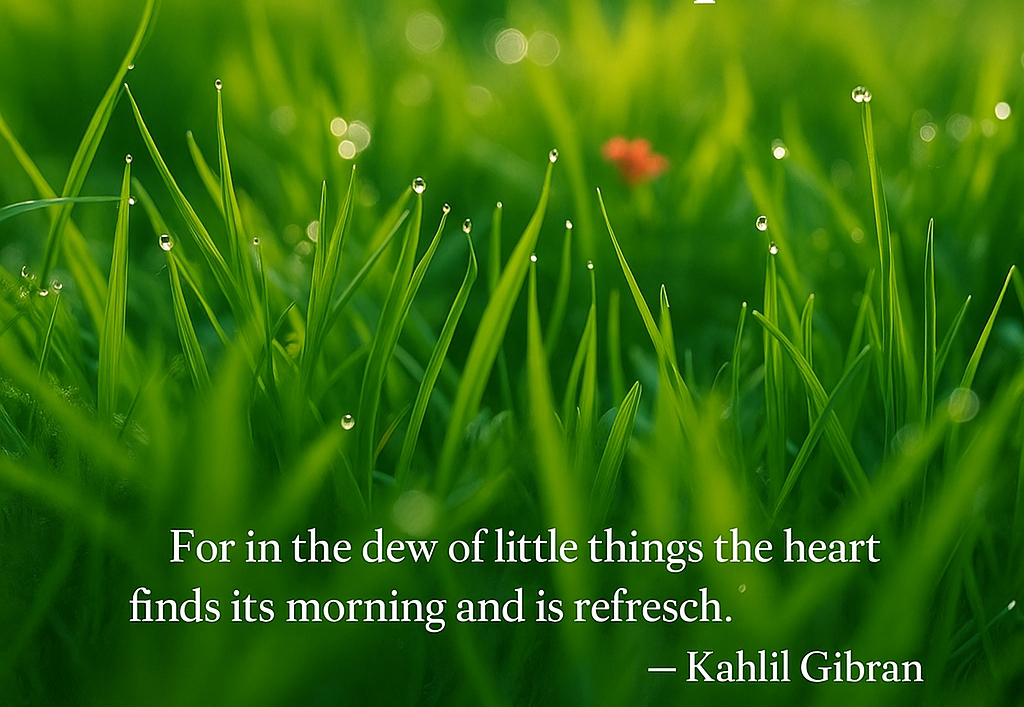
And in the sweetness of friendship let there be laughter, and sharing of pleasures. For in the dew of little things the heart finds its morning and is refreshed.
In the end, it’s the little things that stay with us: A shared joke from childhood, the comfort of speaking your mind without explaining yourself, that one sentence only they would understand.

These moments don’t serve a grand purpose. They just refresh the soul, like morning dew.

Saturday, June 28, 2025

Ud Jayega - When life whispers its uncertainity

It was just another day-end time, when I was sitting in my cab heading back from office. Amazon music was playing softly - my little ritual to shake off the day's stress.
But my thoughts were elsewhere.
Wandering around the distressing news I’d heard over the last couple of days

An airplane crash… 241 lives gone in seconds, dreams dissolved mid-air.
A young soul lost, suddenly to sheer fatigue.
A retired uncle from our neighboring society gone while simply watering plants on the 14th floor. A small slip, a fatal fall. Just like that.
How uncertain life really is!! I wondered.

And just then, "Ud jayega hans akela" started playing, as if responding to my thoughts. The song felt more soothing than ever. I switched it to repeat mode for the rest of the journey. 
The song reflects on the impermanence of life, the futility of material attachments, and the inevitability of death.

It didn’t explain life.
It didn’t fix anything.
But it gently reminded of a truth we often forget:

We’re all just passing through.
No one knows for how long.
So maybe — just maybe — the point isn’t to chase or hold too tight.
But to be present. To love a little more. To breathe.
"Ud jaayega, na aayega, hans akela..."
The soul will fly away, never to return.
Alone.
There is a quiet fear in that truth.
But there’s also a strange kind of peace - the kind that doesn’t promise control but invites surrender.
Surrender to the now.
To the breath.
To the people who still sit beside us.

🎵 Lyrics and song here

Seenchega Kaun Hum Jo Murjhaayen
Thaamega Kaun Hum Jo Gir Jaye

Ud Jaayega, Na Aayega, Hans Akela

Ruk Ja Zara Kaise Samjhayen
Tu Jo Kahe Vaise Ban Jaayen

Sabar Ki Ungli Thaam Le
Safar Pe Naa Ja Musafir Samjhen Nahi Hain Jo Kabhi

Jo Naa Suna Hai Bata Phir
Tu Tere Raste Main Mere Raste

Rona Hai Phir Kyo Chal Hanste Hanste
Ud Jaayega, Na Aayega, Hans Akela


Wednesday, June 11, 2025

Not a Leap, But a Spiral

Inspired by a corporate training session, this thought stayed with me...
What if the secret to managing change wasn’t found in strategy decks—but in sunflowers and seashells?

The Beauty of Fibonacci

The Fibonacci sequence is a simple yet profound number pattern:
0, 1, 1, 2, 3, 5, 8, 13, 21…
Each number is the sum of the two before it. 
I remember getting introduced to this topic in high school. Back then, it was just a number pattern in maths - interesting but abstract.

What makes it fascinating is how often this pattern appears in the natural world:
🌻 Sunflower seeds arranged in perfect spirals.
🐚 Shells expanding in logarithmic harmony.
🌲 Tree branches and pinecones aligned to optimize sunlight and growth.
🌼 Even flower petals often follow Fibonacci numbers-3, 5, 8, 13...

Nature grows patiently and purposefully. There’s no rush,only rhythm.

Fibonacci, Atomic Habits, and Change

When I re-learned about the Fibonacci concept during a corporate training, it struck a chord.
It reminded me of the ideas from Atomic Habits by James Clear: Start small, stay consistent, let it compound.

Fibonacci indeed isn’t just a pattern in nature. It’s a pattern for change.

The Fibonacci Flow of Change

1. Start Small - 0, 1

Every transformation begins with a tiny step. It might be a mindset shift, a small pilot, or simply showing up with intention.
At first, it may seem too minor to matter—but that’s where real change begins.

2. Build Gradually -1, 2, 3

Each step builds on what came before.
Like the Fibonacci series, change draws from the past and looks to the future, growing with confidence and clarity.

3. Grow Organically - 5, 8, 13...

As change compounds, it gathers momentum. Teams align, systems adapt, and what once felt uncertain becomes second nature. Change doesn’t feel like disruption, it feels like evolution.

Why This Matters

In a fast-paced world, we’re pushed toward “instant transformation", we realize that lasting change isn’t a leap, it’s a spiral.

Just like in nature, meaningful change happens when we:

🌱 Respect sequence
🌿 Scale thoughtfully
🌳 Grow organically

The next time you're navigating change-whether it’s personal, professional, or organizational-pause.

Think of the sunflower...the seashell... the Fibonacci sequence...

Nature knows what it’s doing.

Saturday, April 12, 2025

Empty Your Cup

A young scholar once travelled across the land to meet a revered Zen master. He had studied scriptures, philosophies, sciences, and poetry. His shelves were lined with books; his head, with knowledge.

“I’ve read almost everything,” he told the master, “but I seek deeper wisdom. Teach me.”

The master nodded and invited him for tea.

As the scholar spoke — about his views, his interpretations, his brilliance — the master began to pour tea into his cup.

He poured. And poured. And kept pouring, even after the cup overflowed.
“Stop!” the scholar exclaimed. “It’s spilling over! Can’t you see the cup is full?”

The master gently placed the kettle down and looked at him.

“Exactly,” he said. “How can I teach you anything unless you first empty your cup?”

I’m reminded of this story often — especially when I catch myself, or others, believing we’ve seen enough, learned enough, suffered enough. That we somehow know more than others.

That’s when I remind myself: it’s time to empty the cup.

The scholar, filled with knowledge and assumptions, had no room left for insight. The master’s simple gesture revealed a profound truth — that true learning begins only when we are willing to let go of what we think we know.

We grow up with a certain idea of how life should unfold — who’s ahead, who’s struggling, who’s “meant” to succeed. Sometimes, those early impressions stick. The ones who topped every test, shone in every competition — they seemed destined for greatness. And some of us just quietly accepted our place in the background.

But life has its own rhythm. It flips the script in unexpected ways. The brightest stars at 16 may not shine the same way at 40. The ones who stumbled early might find their pace later. And those who seemed “lucky” may simply have been quietly navigating their path, making the best of each twist and turn.

It’s tempting to blame fate — for what didn’t go right, for the dreams that didn’t materialize. But sometimes, clinging to the story of “bad luck” becomes a shield — one that protects us from confronting our own choices, or even acknowledging that everyone’s fighting their own silent battles. 

The narratives we construct about ourselves and others often don't hold up to reality.  True peace comes not from winning or proving ourselves, but from emptying our cup full of comparisons, old narratives, and the need for external validation. 

May we learn to approach life with humility of an empty cup and may we find peace and wisdom in embracing the beauty of the unknown.

Tuesday, February 25, 2025

Train Journeys & Time Travel

The rhythmic movement of the train, the constant hum of conversations, the occasional cries of babies, fill the compartment. A father walks up and down the aisle, gently rocking his crying child, trying to calm him. It all feels familiar, yet different.

Sitting in the Rajdhani Express to Goa with my parents, I find myself lost in a stream of memories.
There’s something special about train journeys. They aren’t just about getting from one place to another; they carry stories, emotions, and nostalgia. As I glance at the kids in the nearby berths-laughing, climbing up and down, fighting over the window seat, I can’t help but be reminded of my own childhood travels. The excitement of summer vacations, the thrill of hopping from one berth to another, the joy of watching the scenery shift from city to hills and plains.

As I watch the changing landscape outside, another journey from long ago comes rushing back to me.

The last time I traveled to Goa by train to my maternal uncle's home, I must have been around ten years old. The rain was relentless, pouring down, drenching everything in sight. I remember the train getting delayed, the tracks submerged in water, and the journey being abruptly halted a few stations away from our destination. I had no idea what was going on with Mom and Dad or how they were managing our luggage in all that chaos. All I and my sis cared about was the magical world outside, lush greenery, overflowing waterfalls coming down the hills. The weather was perfect, and for us, it was nothing short of an adventure.

We had to switch to a bus from the point where the train stopped. The bus was packed to the brim, barely any room to breathe. But somehow, my sister and I managed to get seats near the driver’s cabin, while Mom and Dad stood the entire way. I remember a lady standing close to us, carrying a basket that smelled strongly of fish. But what I remember most about her was her warm, kind smile and she was saying something in Konkani which I didnt understand.

Back then, I lived completely in the moment, soaking in the beauty of the journey, blissfully unaware of the struggles my parents faced. 

Today, as I sit in this train, I see the same journey through a different lens. I’m no longer the carefree child who only cares about the scenery. Now, I find myself keeping an eye on my dad, making sure he doesn’t indulge too much in sugary tea and sweets. I glance at my mom, noticing her anxiousness, reassuring her with a simple nods.

As I sit in this train, lost in nostalgia, another journey from a different phase of life comes to mind, one from my youthful spinster years, when I traveled with my  friend. It was a special trip, not just because of the destination but because of where I was in life. I was about to get married in a couple of months, stepping into a new chapter, leaving behind the carefree days of singlehood.

That night, we didn’t sleep. We talked endlessly, laughing, reminiscing, soaking in the moment as if we could somehow make time pause. We knew that life was about to change, that things wouldn’t be quite the same again. We wanted the train to halt just a little longer, to let us hold onto that fleeting phase of life. There was excitement, but also a quiet ache, an unspoken understanding that this moment was special because it would never come back.

It’s interesting how train journeys seem to mark these transitions in life. As a child, they were pure adventure. As a young adult, they were filled with deep conversations and emotions. And now, they are moments of reflection, of watching over the very people who once watched over us. We start noticing the little things, their silent worries, their unspoken exhaustion, their need for reassurance.

This train ride made me realize that the scenery outside keeps changing, just like life itself. But some things, memories, emotions, and the love we carry stay with us, no matter where the journey takes us next.

Monday, February 3, 2025

The Underrated Virtue of Gratitude

I have written about gratitude in some of my earlier posts as well. I write about it again today, because I feel its extremely underrated tool towards betterment. I feel that people nowadays tend to complain a lot, and sometimes they have valid reasons to do so.  I agree with their concerns but I wonder if they are looking at the bigger picture.

I am not immune to complaining and cribbing either.. I am no saint and things do affect me.  But, I learnt early in my life that appreciating the little things in life helps us be not dissappointed and we tend to get pleasantly surprised often with the gifts that life brings to us. By keeping our hearts open we discover that the world gives us back more than we expect. 

Gratitude is a calming balm for our mind and heart, reminding us that even in uncertain times, there is always something to be thankful for. 

Some of my previous posts around the same theme :

Gratitude is a muscle that can be developed with practice. Start small. Start it today. 
Taking just a few minutes regularly to write down what you’re grateful for can truly transform your mindset. 

Here’s how it helps: 
Shifts Your Perspective: Focusing on the positive aspects of your life helps you see the silver linings, even on tough days. 
Reduces Anxiety & Depression: Research shows that expressing gratitude can lead to lower levels of anxiety and depression, promoting a more optimistic outlook. 
Enhances Well-Being: This simple practice brings feelings of contentment and joy, helping you appreciate the little things. 
Encourages Reflection: Taking time to reflect on your blessings cultivates mindfulness and a deeper connection to your life. 

In today's world, where uncertainty can be overwhelming, cultivating gratitude can be a powerful anchor. It helps us stay grounded, focused on the present, and be appreciative of what we have, rather than getting caught up in worries about the future or regrets about the past.

I would end this post with a poem written by Kalidasa: 

SALUTATION TO THE DAWN 

Look to this day! 
For it is life, the very life of life. 
In its brief course 
Lie all the verities and realities of your existence: 
The bliss of growth 
The glory of action 
The splendour of achievement. 
For yesterday is but a dream 
And tomorrow is only a vision, 
But today well lived makes yesterday a dream of happiness 
And every tomorrow a vision of hope. 
Look well, therefore, to this day! 
Such is the salutation to the dawn.


Sunday, January 5, 2025

Consume or Dismiss a thought

Best thing I did in 2024 was to read the book "Atomic habits" and it sparked a chain reaction of reading many other books, some self-help books, some one-time read novels and some audio books; And, somehow I was able to make time for many things which I genuinely am interested in. Reading more also enabled me to write more. 

Like every year, 2024 taught me some valuable lessons. 
Here I will share 2 of the significant takeaways which I wanted to document. 

1. Embracing humility - Be Humble, but ensure that it is not misinterpreted as lack of confidence, assertiveness or strength. Embodying humility does not mean that we agree with everything that others say, and avoid confrontation at any cost. It does not mean we are always trying to please others and appease them. It does not mean that we believe everything we hear. It does not mean that we allow ourselves to be intimidated, taken advantage of, and manipulated. 
It means that we recognize our limitations and are open to growth; we are here to learn from one another and we are here to help and be helped.

2. Mindful consumption of thoughts:
“When you drink water from a cup, it becomes part of you. When water falls on you like rain, it evaporates a few minutes later.
Is this thought nourishing? Is this feeling something you should drink? Or is it more like getting caught in the rain?
You’ll always feel the rain, but you don’t have to drink the rain. You can let the thought pass and in a few moments the sun will return. You don’t have to claim everything you feel.”
 This analogy by James Clear resonated with me deeply. It highlights the power of choice in managing ones thoughts and feelings. By recognizing that we dont have to internalize every feeling, we can learn to navigate challenging situations. It is up to us on consuming or dismissing a thought.

Negativity is inevitable. Practice to observe the negativity, learn from it and let it go. Remember, you get better at what you practice, 

What do you plan to practice this year?? Whatever your goals are, remember that small consistent steps can lead to profound transformation. 

Monday, December 9, 2024

Louder, Flashier, Shallower - My Rant about Action movies

I just watched Pushpa 2 over the weekend. This is it! "I am not going watch any action movie from now on", I said to myself. 

Action movies in general are incredibly boring and head hammering with loudness. More so with the likes of Pushpa, Animal, KGF. I wonder what hapenned to Indian film industry, every other movie running in theatre is of the same genre, where violence is glorified, and the protaganist promotes narcissism, glorifies ego, romanticises violence. Emotional depth, vulnerability, or moral dilemmas are completely sidelined.

When younger minds ( I guess older minds too),  when they watch movies like this, it might have corrossive influence, consuming the toxic ideas of masculinity, materialism, superficial self importance, style over substance, violence over storytelling, ego over empathy . 

Why is it that movies like Bahubali and RRR dont feel equally wrong, while these movies too are action packed.? 
It is the strong story telling with roots in selflessness and justice that makes it different. The protoganists act for the greater good - whether its kingdom or freedom. Also the themes of mythological and historical contexts make them larger than life and the action is seen more as a story than reality. Their actions are rooted in universal values, making them inspiring rather than problematic. The emotional threads give us a sense of purpose and connection, rather than just mindless action or glorification of ego.

May purity of thought, word, and deed prevail in our lives and in the world around us. May we strive for truth, compassion, and kindness, and may these values guide us towards a brighter and  harmonious future.

As the ancient Indian mantra goes: 

"Asato ma sad gamaya, tamaso ma jyotir gamaya, mrityor ma amritam gamaya" 

"Lead me from the unreal to the real, from darkness to light, and from mortality to immortality."

Saturday, October 26, 2024

Mesmerising Memoirs and My Ramblings

There is something special about memoirs. I realized lately that I love reading memoirs when compared to fiction, and in fiction, fiction narrated in the form of memoirs. Mitch albom's "Tuesdays with Morrie" and other novels, Shantanu naidu's " I came upon a light house". Recent addition to the list is "Born a crime" by Trevor Noah. I tend to like memoirs more than autobiogrpahies. Afterall, nobody can have their entire life interesting. It is the slices of the life, the most interesting parts of the author's life that connects with the reader. Memoirs cherry-pick the most significant, interesting or transformative events, making them more engaging. 
 
One is daily journalling, which is basically reflecting on the events that occurred during the day ( one or two days old reflection) . And the other is when you go down the memory lane.. many years back...  I am now doing some random rambling on the later one. 

When we look back at our past after many years, we are, in fact, two different selves. One is the person who was left behind somewhere in the memories of a bygone time, and the other is the mind that is observing all of it objectively. One is what is visible, and the other is what is unfolding within the mind. Isn't this awareness of two selves both liberating and unsettling, as we try to make sense of who we are and where we are going?

We can never quite grasp this play of fleeting time and past memories. We try to gather what has slipped away, while remaining detached from what is flowing in the present. As we move forward, we end up somewhere else—not just far from our origin, but also very far from ourselves. So far that when we try to look back and understand ourselves, it feels almost impossible. Even our memories gradually begin to fade away.
When we journal with this awareness of two selves—past and present—it seems like we are embracing this duality, almost like writing our own evolving memoir. This awareness adds depth to how we understand both memory and identity. 

Do you resonate with this thought or are you thinking "Akhir kehna kya chahte ho?" 😅


Saturday, October 19, 2024

The Art of Racing in the Rain

Despite not being a dog or car enthusiast, I found the book captivating. Its unique perspective, storytelling, and lessons on resilience and navigating life's challenges made it a truly insightful experience.

"The Art of Racing in the Rain" by Garth Stein is unique. It's told from the point of view of a dog named Enzo. It’s a touching story about family, love, and life's struggles, seen through the eyes of a dog with the soul of a philosopher.


Some notable quotes from the book :

"So much of language is unspoken. So much of language is compromised of looks and gestures and sounds that are not words. People are ignorant of the vast complexity of their own communication."

"To be a champion, you must have no ego at all. You must not exist as a separate entity. You must give yourself over to the race. You are nothing if not for your team, your car, your shoes, your tires. Do not mistake confidence and self-awareness for egotism."

"Learn to listen! I beg of you. Pretend you are a dog like me and listen to other people rather than steal their stories."

"Here’s why I will be a good person. Because I listen. I cannot speak, so I listen very well. I never interrupt, I never deflect the course of the conversation with a comment of my own."

"It makes one realize that the physicality of our world is a boundary to us only if our will is weak; a true champion can accomplish things that a normal person would think impossible."

"Such a simple concept, yet so true: that which we manifest is before us; we are the creators of our own destiny. Be it through intention or ignorance, our successes and our failures have been brought on by none other than ourselves."

“There is no dishonor in losing the race,” Don said. “There is only dishonor in not racing because you are afraid to lose.”

"A winner, a champion, will accept his fate. He will continue with his wheels in the dirt. He will do his best to maintain his line and gradually get himself back on the track when it is safe to do so. Yes, he loses a few places in the race. Yes, he is at a disadvantage. But he is still racing. He is still alive. The race is long. It is better to drive within oneself and finish the race behind the others than it is to drive too hard and crash."

Highly recommend it for anyone looking for a quick thought provoking read.

Saturday, September 14, 2024

Where the mind is without fear

Where the mind is without fear and the head is held high
Where knowledge is free
Where the world has not been broken up into fragments
By narrow domestic walls
Where words come out from the depth of truth
Where tireless striving stretches its arms towards perfection
Where the clear stream of reason has not lost its way
Into the dreary desert sand of dead habit
Where the mind is led forward by thee
Into ever-widening thought and action
Into that heaven of freedom, my Father, let my country awake.

- Rabindranath Tagore

I remember this iconic poem since childhood. During our very long assembly time at school, this was one of the poems that we recited daily. At that time, I think I didn't realise the power of these lines. What a powerful plea to the divine to awaken the country to this vision of freedom!! I am now glad that I had this experience in school and realise how it had impact on my younger subconscious self, even if full understanding and appreciation came later.

It's interesting how our perspectives and understanding of literature can evolve over time. As we grow and experience life, we can appreciate the depth and complexity of poems like this one. The lines that once seemed simple or abstract can now resonate with us on a deeper level.
Do you have a similar memory from Childhood? Any poem or story which is imprint in your mind from childhood? Do care to share with your younger ones and friends. You never know, when a small spark enlightens the other life. 


Saturday, August 10, 2024

A Lesson learned at 30K feet - Breathe, Reflect, Repeat

I grasped for breath as I reached airport and rushed towards the counter for check-in counter. "How could I be so careless?!", I cursed myself. It was quite a run, when I realised that the flight is at 5:40 pm and not 6:40 pm. I ran towards the flight as the last call for passengers was being announced. I just didnt care that people were giving me weird looks when I was running fanatically while grasping for breath. I breathed a sigh of relief when I entered the flight. Took my seat, wiped the sweat on my face, took a few long breaths. I checked my mobile phone which was about to die with 10% battery. "10% -S××××!!!", I cursed myself again!  I messaged the important people that I have safely boarded by flight and switched it off, as i would need the remaining % battery when I reach the destination.


Switiching off mobile sometimes is a liberation. Feeling disconnected with the OCD of looking at mobile is a blessing... in disguise... Opened my diary and wrote 2 times - How could I be so careless!!! ,and ruminated over this for the rest of the duration of the flight.

We do this all the time! Dont we? Having worked in IT operations for years now, I know the costs of being careless. One wrong click on a production environment can have an inexplicable huge impact.   And yet it happens sometimes. 

We need to develop that awareness and attention. You dont become mindful overnight and it doesnt come easily. Like all skills, being mindful requires practice.
Some of the ways to develop this consciousness are below:
1. One thing at a time - We constantly juggle with mutiple things at a time. We boast of being multi-taskers. But the fact is that you cannot be conscious of multiple things at once. In this episode here, I was multi talsking and I didnt prioritize checking the flight details till the last moment. You need  to pay deliberate attention to each thought and feeling that arises in your experience. Practice developing awareness of just one thing at any given moment.
2. Acceptance -  Observe the moment with acceptance and love without being judgemental. Temporarily, let go of the need to change, fight, or deny any aspects of your experience. Let it be. Observe and accept.
3. Focus on Now - There is nothing you can do to magically alter the past. Let go of past and future… they are illusions.  Focus on Present to change the future by choosing right things now.
4. Journal your experience - Once you begin to realistically notice, describe, and accept your present-moment experience just the way that it is, you will have the power to make new choices and develop new behavioral patterns.. which is what I am doing now by writing this post. :)
5. Meditate - try to disconnect with thoughts everyday for a few minutes. This gives more clarity every day.

Lets try to consciously attempt to improve the awareness, attentiveness and carefulness.

Until next time...

Wednesday, July 24, 2024

Persistence and Flexibility

Last week marked my 18th year in this incredible IT industry.  Reflecting on the years that have passed, I realise how every moment has been an amazing learning opportunity. Here are my musings on these learnings beyond the technical aspects:

Has it always been fulfilling ? Perhaps, Not.
There are some days when I might have cribbed about the job, about the coworkers, about increment, etc.  But in my view, the key is Persistence and Self awareness. 

Persistence is self-discipline in action. The belief that the events that take place through out one's life are conducive to ones elevation and that there is no good or bad event, helps us find opportunity in all circumstances, for us to be assertive.

Self Awareness is knowing that we become unstoppable when we work on things that cannot be taken away - our mindset, our character, personality, authenticity, integrity and our entire being. 
We must keep assessing inner wisdom and let it guide us towards growth.

The other aspect is flexibility. Flexibility is often seen as a weakness. However, in my view it is not only a tool for survival but also allows you to achieve goals in the constantly changing world.

At first glance, you may feel that persistence and flexibility are paradoxical. Because, while persistence implies to sticking to a plan, being rigid, and maintaining a consistent approach, flexibility implies adaptability, being open to change and adjusting the plans as needed.  But when you think about it at a deeper level, you will wonder how interconnected these two qualities are and how they complement each other when balanced correctly. 

This reminds me of the classic fable  about the big tree and a plant. The story goes like this:

A big, strong tree stood tall and proud, often looking down on the smaller, seemingly weaker plants around it. Among these was a small plant that the tree considered insignificant. The tree boasted about its strength and ability to withstand any force of nature.

One day, a fierce storm hit. The strong winds blew relentlessly, and the big tree, despite its strength, struggled to stay upright. Eventually, the tree was uprooted and fell. However, the small plant, which could bend and sway with the wind, yet firm on the roots survived the storm unscathed.

The moral of the story is that flexibility and humility can sometimes be more advantageous than sheer strength and pride. Those who can adapt to changing circumstances often survive and thrive, even when faced with great challenges. The persistence of the plant to remain fixed on the roots and the flexibility of the branches to bend and adapt to the winds helped the plant to navigate the obstacles and be successful.


Saturday, May 18, 2024

Survival of the fittest

I was surfing on youtube when I came across a video where birds were plucking the hair of the deer. 
It was a cute video showing the deer enjoying a free hair cut while the birds collected raw material to build their nests. This got me thinking. 

Over the years we have had a narrow belief that the survival of the fittest means that the strongest always wins. "Fittest" meant having the competitive advantage over others, winning over others. But in essence, Nature teaches us that  "Fittest" are often those who can coexist and support the health of their community.
"Fittest" can mean the most effective collaborators, those who create independent web of ecosystem. 

There are many such examples in nature of such symbiotic relationships. Food for thought - Are we intune with nature in this aspect? What can we do differently to cooperate and evolve within our ecosystems and with our fellow beings?

Signing off with this thought.
Love & Peace.

Saturday, April 20, 2024

Navigating Disappointments with Grace and Gratitude

As appraisal cycle results approach, it's natural for some individuals to feel a sense of unfairness or disappointment, especially if they perceive their efforts haven't been adequately recognized or rewarded.It is easy to slip into bitterness. But thats a trap!! Avoid this trap if you are smart but disillusioned. Succumbing to bitterness only perpetuates a cycle of negativity that ultimately hinders personal growth and fulfillment.

The most bitter people are the smart people who are not as successful as they thought they should be, because they feel that they are shining and the world should fall at their feet, but it doesnt workout that way. 

I dont say that you should not disagree with the outcome. It's important to acknowledge and validate those feelings of disagreement or frustration. However, how we choose to respond to those feelings is what ultimately shapes our experience and future outcomes. While it's understandable to feel disappointed or even upset, allowing those emotions to fester into bitterness can be detrimental both personally and professionally.

The key lies in recognizing that success is often subjective and multifaceted. While one may excel in certain areas, they may face challenges or setbacks in others. Moreover, success is rarely instantaneous and often requires perseverance, resilience, and a willingness to adapt to changing circumstances.

By cultivating an attitude of gratitude, individuals can shift their focus from what they lack to what they have accomplished and experienced. This mindset not only fosters a greater sense of fulfillment and contentment but also opens doors to new opportunities and perspectives.
Embracing humility and acknowledging the contributions of others can foster stronger relationships and collaboration, ultimately leading to greater success and satisfaction in the long run. The picture above summarizes how gratitude can be practiced and its benefits.

A drop a day - practice gratitude every single day. Attittude of gratitude takes us long way.

Love & Peace!

Sunday, February 18, 2024

From Flaws to Freedom


I ordered this book last year. And have finally finished reading it. I must confess that it felt like an eternity to finish the book. There were moments where I did feel a little bored. But I managed to continue and it's overall thought provoking and impactful. The time invested in understanding his journey and philosophy feels incredibly rewarding. 
In an era dominated by misinformation and propaganda, Gandhi's autobiography, "The Story of My Experiments with Truth," stands as a beacon of authenticity and integrity. In a world where narratives are often manipulated to serve particular agendas, to diminish Gandhi's legacy and distorting his contributions, his firsthand account offers a genuine and unfiltered perspective on his life, principles, and struggles.

I am particularly amazed at the willingness to openly acknowledge his own flaws and imperfections. This enhances the credibility of  the narrative. In an age where public figures are often portrayed as flawless or infallible, Gandhi's humility and honesty serve as a refreshing reminder of the importance of sincerity in leadership. Gandhi openly discusses various mistakes and moral lapses he experienced in his life. He acknowledges the past errors like telling lies, experimenting the consumption meat and alcohol, etc. Few other flaws that he admitted :

Fear of Public Speaking: Gandhi candidly discusses his fear and hesitation when it comes to public speaking. He admits feeling nervous and inadequate as an orator, especially in the early stages of his activism. This vulnerability humanizes Gandhi and makes his eventual growth as a communicator all the more remarkable.

Struggles with Anger: Throughout the autobiography, Gandhi reflects on his struggles with anger and impatience. He acknowledges instances where he acted impulsively or harshly, often regretting his behavior afterward. Gandhi's honesty about his temper underscores his commitment to self-improvement and nonviolence.

Shortcomings in Parenting: Gandhi reflects on his shortcomings as a parent, admitting that he fell short of his ideals at times. He acknowledges moments of impatience and inconsistency in his interactions with his children, highlighting the challenges of balancing personal commitments with public responsibilities.

Doubts and Uncertainties: Gandhi doesn't shy away from expressing his doubts and uncertainties throughout his journey. He openly discusses moments of spiritual and moral confusion, and his own role in the struggle for independence.

Gandhi's journey from a hesitant advocate to a global leader demonstrates that true leadership is not about being flawless or fearless, but about embracing vulnerability, learning from failures, and striving for personal growth and authenticity. 

I highly recommend this book to everyone and hope that readers learn to confront their own shortcomings and strive for greater self awareness and moral integrity. 

Delivery Leadership: More Than Plans and Metrics

Nobody tells you this when you become a delivery leader. They tell you about deadlines. They tell you about escalations. They tell you about...